
Every man’s head of hair possesses a unique topographical blueprint. While mannequin heads in barbering academies feature uniform follicle density and predictable forward growth directions, real clients walk into the barbershop with double crown whorls, stubborn frontal cowlicks, asymmetric temple recession, and abrupt changes in hair texture. When an inexperienced stylist applies a generic, cookie-cutter haircut template to these natural growth variations, the result is immediate frustration: crowns stick straight uplike an antenna within days, receding corners look wispy and exposed, and parts refuse to lie flat without heavy pomade.
True master barbering does not fight against the anatomy of the skull or the natural angle of the hair follicle. Instead, precision barbering works in harmony with your biological growth patterns. In this technical grooming guide from Albakir Barbershop in Oakville, we examine how master barbers diagnose follicular inclination, calibrate shear graduation weight, and engineer tailored fades for managing cowlicks, receding hairlines, and complex hair growth patterns.
Understanding the Anatomy of a Cowlick and Crown Whorl
A cowlick occurs wherever hair follicles emerge from the scalp dermis at a steep, spiraling, or opposing angle relative to the surrounding hair shafts. Most commonly located at the posterior vertex (the crown) and along the anterior frontal hairline, cowlicks are genetically determined rotational vortices.
The Golden Rule of Crown Length: Leave It Very Short or Leave It Heavy
The single most common mistake in men’s haircutting is cutting a crown cowlick to a medium length – typically between 0.5 inches and 1.25 inches (such as a #4 to #6 clipper guard). At this intermediate length, the hair shaft possesses maximum structural stiffness against gravity, yet lacks sufficient weight to bend downward. Consequently, the hair springs straight out at the exact angle of the follicle.
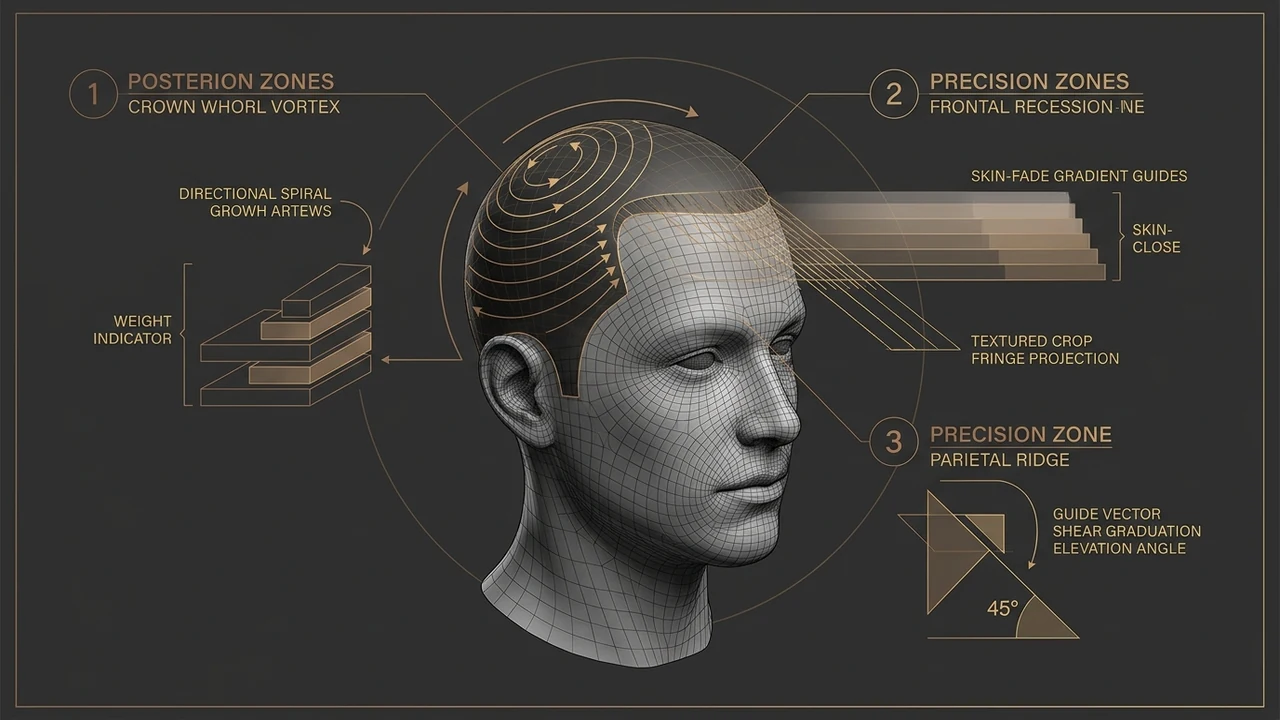
Master barbers neutralize stubborn crown whorls using one of two geometric strategies:
- The High-Weight Gravity Strategy (2.0+ Inches): By preserving at least two to two-and-a-half inches of length through the crown and utilizing over-direction during shear work, the natural physical weight of the hair shaft overcomes the upward lift of the follicle, allowing the crown to lie smoothly along the occipital contour.
- The Crop-Down Strategy (#1.5 to #2 Guard with Grain): For men who prefer ultra-low-maintenance short styles, taking the crown down tight in the direction of the whorl removes the lever arm of the hair shaft so it cannot stand up or split apart.
Precision Barbering Strategies for Receding Hairlines and Mature Temples
By age thirty-five, roughly two-thirds of men experience some degree of frontotemporal recession – often forming the classic “M-shaped” widow’s peak or deep temple corners. The instinct of many men experiencing hairline recession is to grow the front fringe longer and comb it forward or diagonally across the bare temples to hide the recession. Unfortunately, long, thin strands draped over receded corners draw immediate visual attention to the scalp contrast underneath.
1. Reducing Contrast With High-and-Tight Temple Fades
Perception of hair density is entirely governed by visual contrast. When the sides of your head are left thick and dark while your front temples are receding or thinning, the dense sides make the top look noticeably sparser by comparison. By executing a crisp mid-to-high skin fade or bald taper along the parietal ridge and temples, a master barber removes the heavy density on the sides. This optical rebalancing immediately makes the hair on top of the head appear fuller, denser, and intentional.
2. The Textured French Crop and Forward Fringe
For men with pronounced temple recession, the Textured Crop is one of the most flattering architectural cuts in modern barbering. By cutting the top to a structured 1.5-inch length with deep point-cutting (creating irregular micro-layers that interlock rather than separating into stringy strands) and pairing it with a blunt, slightly cropped frontal fringe, the receded temple corners are naturally concealed without looking like a comb-over.
3. Avoiding Over-Pushed Lineups at the Frontal Corners
When outlining the forehead lineup with a zero-gapped trimmer, an inexperienced barber will sometimes push the entire frontal hairline backward to match the deepest point of the receding corners. This is a critical error that permanently ages the face and creates harsh dark stubble within forty-eight hours as the pushed-back hair regrows. At Albakir Barbershop, we preserve your natural frontal line at its forwardmost point, gently dusting only stray miniaturized hairs at the vertical temple bars to create a sharp, masculine frame.
Correcting Double Crowns, Flat Occipital Bones, and Nape Swirls
Beyond the forehead and top vertex, complex growth patterns frequently appear along the parietal ridge and the lower nape of the neck:
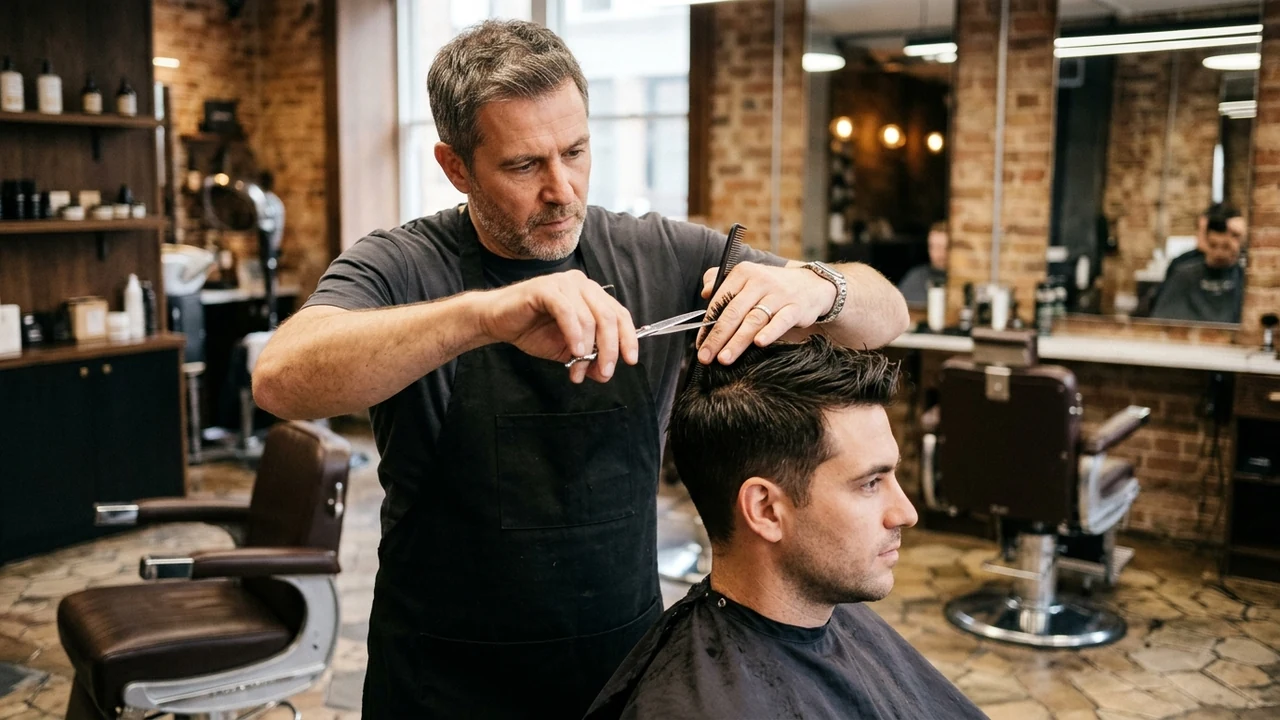
- Flat Occipital Bone Compensation: If the back of the skull flattens out beneath the crown, running a clipper straight up the back removes too much bulk, making the head look flat in profile. Our barbers use clipper-over-comb graduation at a 45-degree outward angle to build an artificial curve of volume over the occipital bone.
- Bullseye Nape Swirls: Many men have hair at the bottom of the neck that grows upward toward the ears or converges toward the center of the spine. When executing a low taper fade, the barber must pivot the clipper wrist radially – always feeding the cutting blade directly against the specific directional grain of each micro-section – to achieve an even, shadow-free gradient.
- Frontal Widow’s Peak Cowlicks: When one side of the front hairline grows upward and backward while the adjacent side grows downward, forcing a side part on the wrong side creates an unruly bump. Always place the side part on the natural split side of the whorl so the hair flows in its native rotational direction.
Styling Products That Control Unruly Growth Patterns Without Greasy Weight
Choosing the wrong styling product can sabotage even the most precise shear work. Men with cowlicks or fine, receding hair should avoid heavy, oil-based greases and wet-look gels, which clump hair shafts together and expose scalp skin.
- Matte Styling Clay or Texturizing Paste: Kaolin and bentonite clays absorb excess scalp sebum, swell the diameter of individual hair shafts, and provide a dry, high-hold grip that locks cowlicks in place with zero shine.
- Sea Salt Pre-Styling Spray + Blow Dryer: Applying sea salt spray to damp hair and blow-drying the cowlick roots downward using a vented brush and medium heat resets the hydrogen bonds inside the hair cortex, training the cowlick to lie flat all day before a single drop of clay is applied.
Frequently Asked Questions
Can you permanently train a cowlick to grow in a different direction?
Because the angle of the follicle bulb is anchored deep inside the dermis layer of the scalp, you cannot permanently alter the biological growth direction. However, daily blow-drying with heat and tension temporarily reshapes the keratin hydrogen bonds from wash to wash, making the cowlick effortless to manage.
How often should I get a haircut if I have a receding hairline or strong cowlicks?
Maintaining a sharp 2-to-3-week maintenance cadence is ideal. Keeping the side taper fade tight prevents lateral bulk from building up around the ears and temples, ensuring the top proportion always looks thick and intentional.