
Minimalist, ultra-short men’s haircuts have defined masculine grooming for over a century. Originally engineered for military readiness, athletic discipline, and effortless daily maintenance, the buzz cut family remains one of the most requested styles in modern barbering. Yet many men sit in the barber’s chair and ask for a “buzz cut” without realizing that the term encompasses several distinct architectural haircuts – each defined by exact millimeter blade lengths, parietal blending rules, and hairline contour geometry.
Walk out with a uniform #0 blade all over when your head shape actually called for a graduated Crew Cut with a skin-tapered temple, and the result can expose scalp bumps or widen a round face. In this precision grooming guide from Albakir Barbershop in Oakville, we break down the exact technical distinctions across buzz cut variations: the Induction Cut, Burr Cut, Butch Cut, and Crew Cut with tapered edges – and how to select the ideal variation for your bone structure.
1. The Induction Cut: Raw Minimalist Uniformity (#000 to #0.5)
Named after the traditional first-day haircut given to new military recruits upon induction, the Induction Cut is the shortest possible clipper cut achieved without lathering up a straight razor or foil shaver.
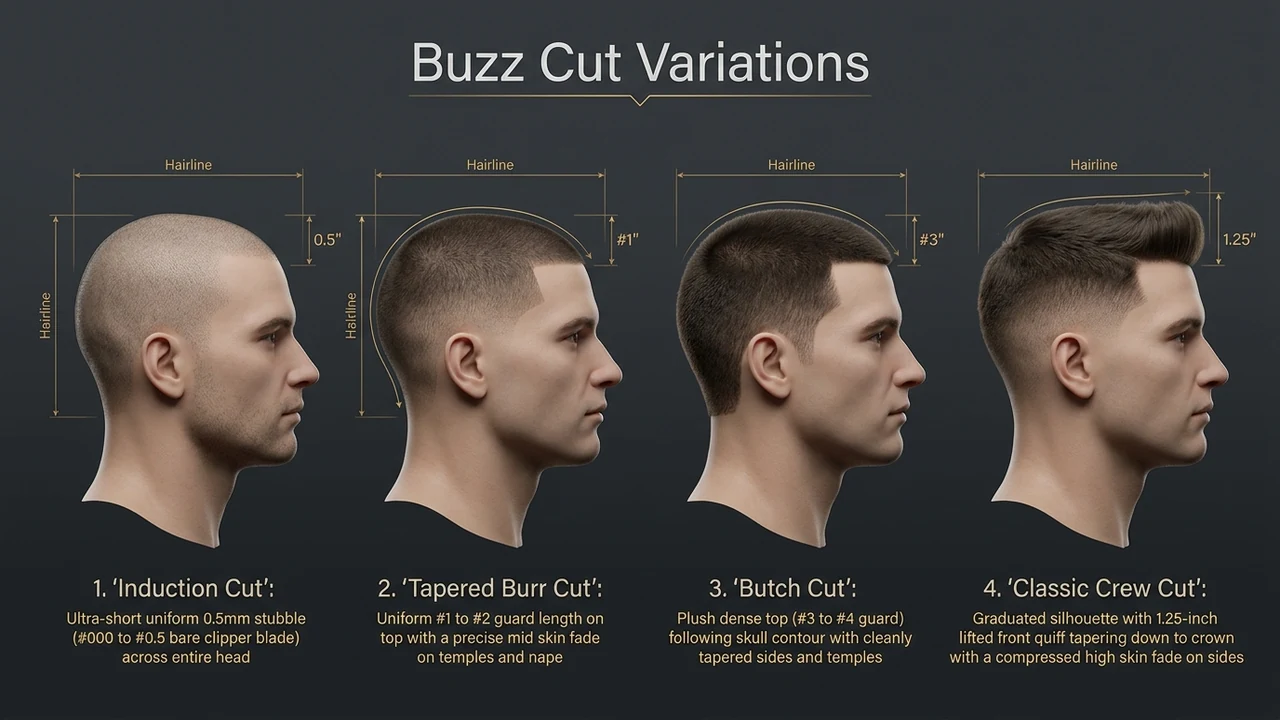
- Technical Blade Specification: Executed uniformly across the entire top, back, and sides using a bare detachable #00000 to #0.5 clipper blade (0.2mm to 1.5mm) with no plastic guard attachment.
- Visual Profile: Leaves a velvety shadow of stubble across the scalp, completely eliminating parting, cowlicks, and styling time.
- Best Suited For: Men with strong, angular jawlines, symmetrical oval or square cranial domes, receding or thinning hairlines where eliminating contrast between the top and sides creates a powerful, youthful aesthetic, and athletes seeking zero maintenance.
2. The Burr Cut: Crisp Stubble With Defined Pigment (#1 to #2 Guard)
Stepping slightly up in length from the raw Induction Cut, the Burr Cut gets its name from the dense, prickly texture of the short bristles left across the crown.
- Technical Blade Specification: Cut to a uniform length using a #1 guard (3mm / 1/8 inch) or #2 guard (6mm / 1/4 inch) across the top of the head.
- Modern Barbershop Upgrade (The Tapered Burr): While a traditional Burr Cut uses the same #1 or #2 guard all over the head, a one-length guard cut often looks puffy around the ears after just five days of growth because side hair appears optically denser than top hair. At Albakir Barbershop, we elevate the Burr Cut by keeping a #2 on top and blending the sides and back down into a mid or high skin fade (#0 to #2) with a razor-sharp forehead lineup.
- Best Suited For: Men with thick, coarse hair who want full scalp pigment coverage without needing comb or pomade styling.
3. The Butch Cut & Brush Cut: Plush Density (#3 to #4 Guard)
When a man wants the clean, no-nonsense silhouette of a buzz cut while retaining enough hair length to show natural texture and rich hair color, the Butch Cut (and its textured cousin, the Brush Cut) bridges the gap.
- Technical Blade Specification: Top length is cut uniformly with a #3 guard (10mm / 3/8 inch) or #4 guard (13mm / 1/2 inch), following the contour of the skull.
- Side & Nape Execution: Always paired with tapered sides – typically fading from a #0.5 or #1 at the temples and nape up into the #3 or #4 along the parietal ridge.
- Best Suited For: Men with slight cranial irregularities or occipital flatness where a #0 or #1 would expose scalp contours, and professionals wanting a softer, fuller look than a militant burr.
4. The Classic Crew Cut With Tapered Edges: Graduated Dimension
Unlike the Induction, Burr, and Butch cuts – which maintain a uniform guard length from the front hairline to the back crown – the Crew Cut introduces true three-dimensional horizontal graduation.
- Technical Architecture: The top is cut longest at the front hairline (typically 0.75 inches to 1.5 inches using shear-over-comb or heavy guards) and tapers progressively shorter as it moves backward toward the crown vertex (down to a #2 or #3).
- Parietal & Temple Blending: The sides are sculpted with a clean low, mid, or high taper fade, creating a squared-off masculine silhouette when viewed from the front that slims round cheeks and elongates the face.
- Styling Versatility: The extra half-inch of length at the front hairline can be brushed slightly upward into a subtle Ivy League quiff or swept to the side with a pea-sized touch of matte clay.
Why Tapered Edges Transform Any Buzz Cut From “Home Clipper Job” to Luxury Grooming
Anyone can snap a #2 plastic guard onto a consumer clipper at home and run it over their head in the bathroom mirror. Yet a single-guard home buzz cut almost always makes the head look round like a tennis ball. Why? Because the human skull curves inward at the temples and outward at the parietal ridge, and hair follicles grow at varying densities across different zones of the scalp.
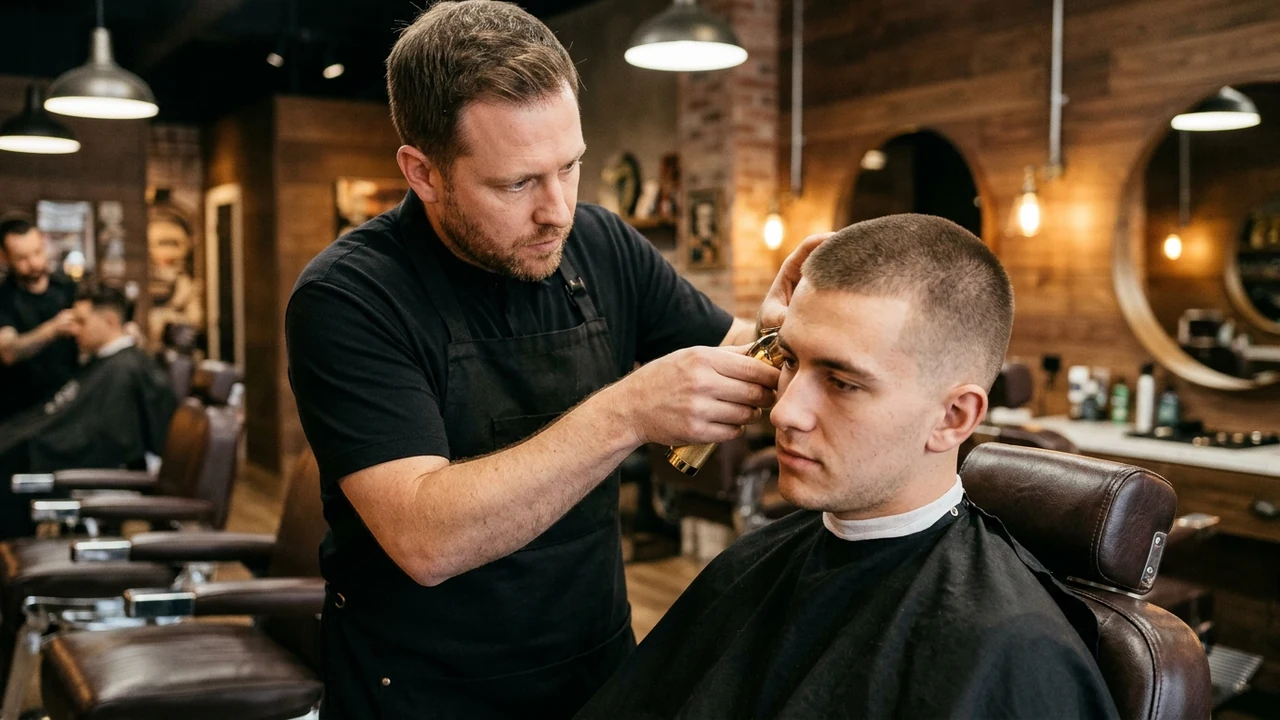
A master barber transforms a simple buzz cut into a bespoke tailored look through three precision details:
- Compressed Temple & Nape Taper: Fading the sideburns and lower neckline down to bare skin (0.0mm foil shaver) removes lateral ear bulk and creates a crisp gradient shadow.
- Crown Contour Calibration: Adjusting guard leverage over the occipital bone and vertex whirl so no dark patches or sticking-up cowlicks appear.
- Straight-Razor Lineup & Beard Integration: Defining the vertical temple bars and seamlessly fading the sideburn downward into a sculpted beard.
Maintenance Schedule & Scalp Care for Short Buzz Styles
- Optimal Re-Booking Cadence: Because millimeter changes in hair length are immediately visible on a #0.5 to #2 fade, schedule a fresh fade and lineup every 10 to 14 days.
- Exfoliation & Moisturizing: Short buzz cuts expose the scalp skin directly to UV sunlight and dry winter air. Use a gentle exfoliating scalp scrub twice a week to prevent flaky buildup, and apply a lightweight, non-comedogenic matte moisturizer with SPF daily.
Frequently Asked Questions
Which buzz cut variation is best for a round face shape?
The Crew Cut with a high skin fade is ideal for round faces. Taking the sides down tight to the skin while leaving 1 inch of graduated height at the front hairline elongates your facial proportions and creates strong vertical structure.
Will a buzz cut make my thinning crown look more obvious?
Actually, the opposite is true. Growing thinning hair long makes strands separate and highlights scalp contrast. Cropping down to a #1 Burr Cut with a skin fade on the sides equalizes density between the top and sides, making thinning areas virtually disappear.