
Deciding to grow your hair out from a short clipper fade into a flowing medium-to-long silhouette – whether aiming for a classic shoulder-length surfer flow, a textured Italian slick-back, or a rugged Samurai topknot – is one of the most rewarding style journeys a man can undertake. Yet the vast majority of men abandon the effort around month four. Why? Because they believe the myth that growing long hair simply means avoiding the barbershop for a year.
When a short tapered haircut grows out untouched for four to six months, the hair at the back of the neck (which starts four inches lower on the skull than the hair at the crown) reaches collar length long before the top and front fringe can even clear the eyes. The result is an accidental, heavy “helmet mullet” with bulky wings puffing out over the ears. In this master styling guide from Albakir Barbershop in Oakville, we detail the exact science of long hair grooming for men: layering, split-end removal, and transitioning styles so your hair looks deliberate and sharp at every single stage of growth.
Understanding the Biological Timeline of Men’s Hair Growth
Human scalp hair grows at an average rate of 0.5 inches (1.25 cm) per month, or roughly six inches per year. If you are starting from a standard short fade (2 inches on top, #1 on the sides), reaching a true chin-to-shoulder-length flow where the front fringe tucks effortlessly behind the ears requires 10 to 14 months of growth.
Because follicles on the top of the head must travel six to eight inches down the curvature of the skull just to reach the bottom of the earlobes – while follicles at the nape of the neck start right at the collar – managing the relative lengths between zones is the entire secret to surviving the awkward mid-length phase.
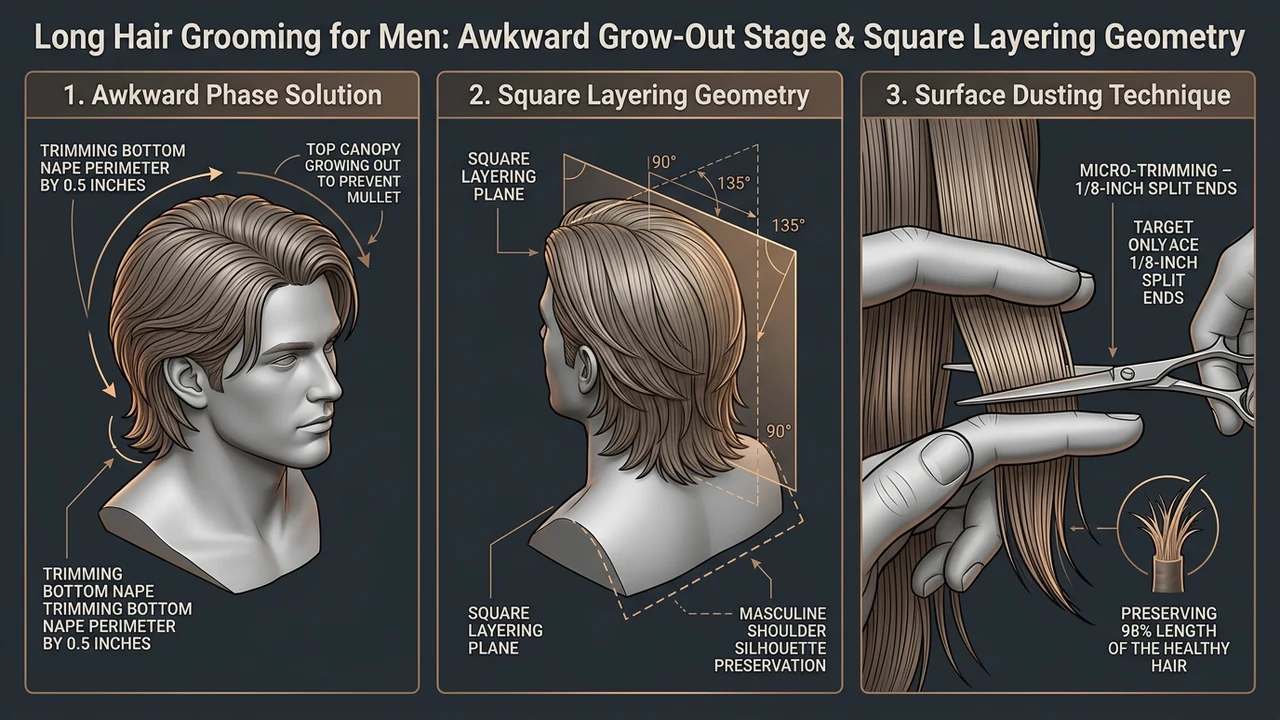
How to Survive the “Awkward Stage” (Months 3 to 8): Strategic Transition Trims
Instead of disappearing from the barbershop for a year, book a Long-Hair Maintenance & Transition Trim every 8 to 10 weeks and ask your barber for three specific technical adjustments:
1. Perimeter Nape Compression (Preventing the Accidental Mullet)
During months three through seven, your barber should leave 100% of the length on the top and upper parietal ridge untouched while gently trimming 0.5 to 0.75 inches off the bottom nape perimeter. Holding the back collar line in check gives the top and front layers time to catch up and overlap the back, creating a unified one-length cascade rather than a bi-level step.
2. Over-the-Ear Weight Debulking & Temple Tapers
The hardest weeks of the grow-out occur when side hair reaches 2.5 to 3.5 inches – too short to tuck securely behind the ear, yet long enough to curl outward over the top of the ear cartilage. Using Japanese thinning shears or internal slide-cutting / channel-cutting inside the parietal ridge removes 30% of the internal bulk without sacrificing external length, allowing the side hair to hug the head smoothly.
3. The Undercut or Low Taper Temple Option
For men with ultra-thick, wavy, or curly hair who want a cleaner professional appearance around the ears while growing out the top, a subtle low temple taper keeps the sideburns and immediate ear contour neat while allowing the main canopy of long hair to fall cleanly over top.
Precision Shear Layering Techniques for Men’s Long Hair
Cutting men’s long hair requires a completely different geometric approach than cutting women’s long hair. Women’s long salon cuts frequently emphasize soft, rounded perimeter shapes and face-framing volume. In men’s long hair grooming, the goal is a masculine, square-layered silhouette that preserves rugged natural movement without looking overly feathered or bouncy.

- Long Square Graduation (90-Degree to 135-Degree Elevation): By elevating sections horizontally and vertically to form a square plane rather than rounding the corners tightly to the head, the hair falls with strong, structured masculine shoulders without poofing out into a pyramid shape.
- Point-Cut Texturizing at the Ends: Blunt horizontal scissor cuts make thick men’s hair sit like a heavy curtain. Deep point-cutting into the final half-inch of the hair ends creates organic, slightly rugged separation that moves naturally in the wind.
Split-End Removal (“Hair Dusting”) Without Losing Length
Once hair passes six inches in length, the tips of the hair shafts are over a year old. Daily friction against shirt collars, pillowcases, UV sunlight, and hot showers strips away the protective outer cuticle scales, causing the internal cortex fibers to fray into Y-shaped split ends (trichoptilosis). Left uncut, a split end unzips progressively up the hair shaft like a run in a fabric seam, causing frizz, tangles, and breakage that actually makes your hair appear to stop growing.
Through a technique called surface dusting, a master barber twists and elevates small subsections under tension, snipping away only the microscopic 1/8-inch frayed tips every 10 to 12 weeks. You retain 98% of your monthly growth while keeping the hair canopy glossy, strong, and tangle-free.
Essential Washing, Conditioning & Styling Routine for Men With Long Hair
- Stop Shampooing Every Single Day: Daily detergent shampooing strips natural scalp sebum before those protective oils can travel down eight inches of hair shaft. Wash with a sulfate-free shampoo 2 to 3 times per week, and use a rich hydrating conditioner from mid-shaft to ends every time your hair gets wet.
- Ditch the Fine-Tooth Plastic Comb on Wet Hair: Hair is weakest and most elastic when saturated with water. Detangle gently in the shower with conditioner in your hair using a wide-tooth comb or boar-bristle paddle brush starting from the bottom tips upward.
- Lightweight Grooming Cream, Argan Oil, or Sea Salt Spray: Replace heavy short-hair pomades with 2 – 3 drops of lightweight argan oil or a light grooming cream applied to towel-dried hair to tame flyaways and enhance natural waves.
Frequently Asked Questions
Does wearing a hat or tying my hair back in a man-bun cause traction alopecia?
Tying long hair back tightly with thin rubber bands every day pulls constantly on the frontal hairline follicles, which can cause traction alopecia over time. Always use snag-free fabric hair ties and keep topknots loose enough that you feel zero skin tension on your forehead.
How often should a man with shoulder-length hair visit the barbershop?
Once you reach your target length, schedule a precision scissor trim, split-end dusting, and neckline/beard cleanup every 8 to 12 weeks.