
Few grooming styles convey discipline, confidence, and uncompromising sharpness quite like military-inspired haircuts. Originating as functional hygiene and safety requirements across global armed services, military haircuts have transcended ceremonial parade grounds to become timeless staples in modern men’s grooming. From executive boardrooms to athletic training facilities in Oakville, Ontario, men consistently choose military haircut variations for their crisp aesthetics, structural durability, and effortless daily styling.
However, stepping into a barbershop and asking for a “military cut” without clear technical terminology often results in miscommunication. A traditional Marine Corps High and Tight represents an entirely different silhouette from an Army regulation side-part or an Air Force low taper. Each variation relies on specific clipper guard transitions, skull contour blending, graduation heights, and hairline edge finishes.
Whether you currently serve in uniform, work in a professional corporate environment, or simply demand an ultra-sharp, low-maintenance aesthetic, this definitive barbering guide breaks down the classic military haircut standard – exploring iconic styles, guard progressions, grooming mechanics, and professional maintenance schedules at Albakir Barbershop.
The Anatomy of the Military Haircut Standard
Every military haircut adheres to foundational barbering principles designed around anatomical symmetry, skin contrast, and weight placement.
The High & Tight: Ultimate Military Contrast
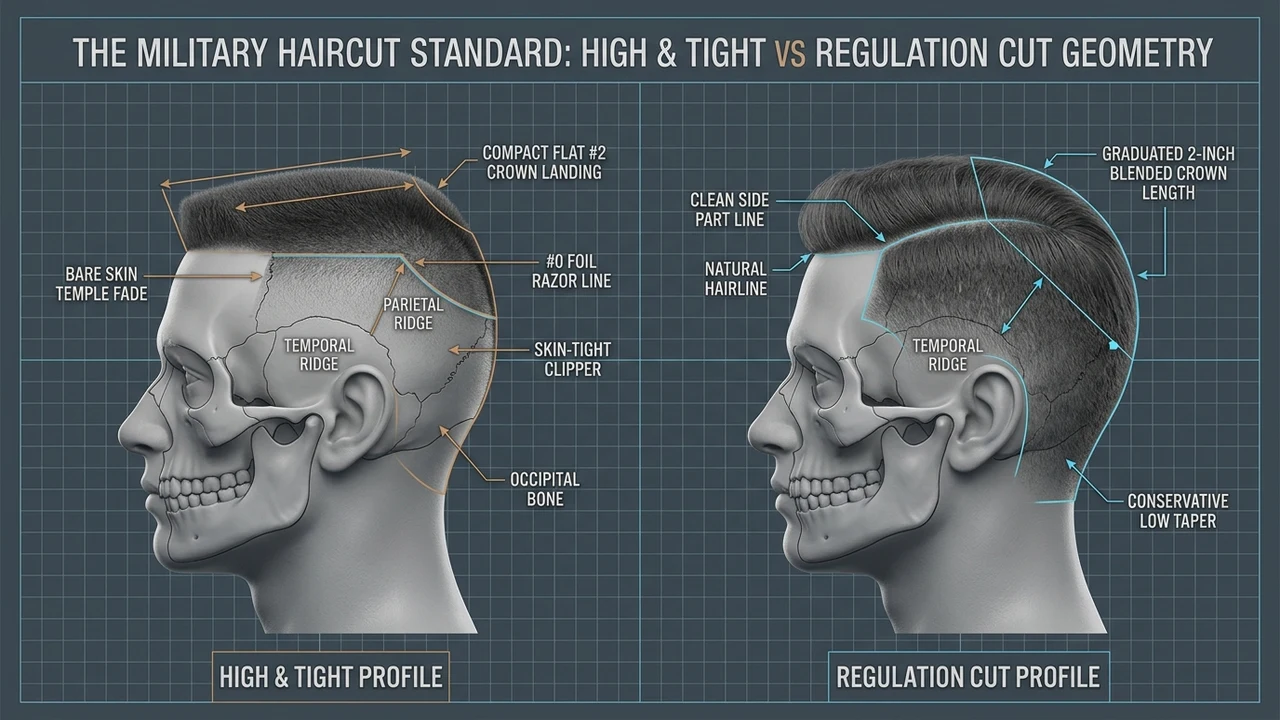
The High and Tight stands as the most recognizable silhouette in armed forces grooming history. Popularized extensively by the United States Marine Corps, this style features aggressive clipper work where the sides and back of the head are shaved down to bare skin (triple-zero or foil shaver) all the way up past the temples and parietal ridge.
The transition between the skin and the top crown hair occurs exceptionally high on the skull, with minimal graduation. The remaining crown hair is clipped short – typically between a #1 guard (3mm) and a #3 guard (10mm) – forming a neat, compact plateau of dark hair resting symmetrically atop cleanly shaved sides. The visual impact is defined by dramatic skin-to-hair tonal contrast that accentuates jawline structure.
The Regulation Cut (The Low / Medium Military Taper)
For service members and corporate professionals seeking a refined, versatile appearance that accommodates traditional hair parts, the Regulation Cut is the gold standard. Unlike the aggressive skin exposure of the High and Tight, the regulation cut preserves sufficient length on top (typically 1.5 to 2.5 inches) to allow a clean, side-swept contour with a defined natural or hard razor part.
The sides and neckline feature a gradual, conservative taper or low skin fade that begins just above the earlobes, leaving substantial density around the parietal ridge. This creates a softer, highly distinguished profile that conforms strictly to armed forces uniform regulations while blending seamlessly into business suits and formal wear.
The Crew Cut and Ivy League Variation
A cousin of the regulation style, the military crew cut keeps the crown short and graduated. The hair is cut shortest at the crown vortex and lengthens progressively toward the front hairline, where the fringe can be brushed up into a tidy mini-pomp or swept gently to one side. When styled with a slight side-part and scissor-finished top, this style transforms into the celebrated Ivy League cut – offering timeless collegiate refinement.
The Burr Cut and Induction Buzz
At the absolute extreme of low-maintenance grooming sits the Induction Cut, named after the iconic buzz received by recruits on their first day of basic military training. The entire scalp is shaved uniformly with a #0 or #1 guard, creating an even, no-frills silhouette. While brutally simple, executing an induction cut cleanly requires precision trimmer outlining around the ears and nape to ensure crisp perimeter geometry.
Mastering the Guard Numbers and Blending Mechanics
Achieving a seamless military cut requires an understanding of clipper guard lengths, lever positions, and head shape mechanics.
Understanding Guard Progressions
- #0 / Foil Shaver (Skin / 0.0mm – 0.5mm): Direct contact with scalp; creates mirror-like skin reflection around the base of the neck and lower ear perimeter.
- #0.5 Guard (1.5mm): The bridge guard essential for erasing harsh baseline skin lines without digging into upper weight zones.
- #1 Guard (3.0mm): Standard high-contrast stubble length providing subtle scalp shadowing.
- #1.5 Guard (4.5mm): Blending zone between the aggressive temple fade and the upper parietal curvature.
- #2 Guard (6.0mm): Conservative military length that obscures scalp visibility while maintaining immaculate cleanliness.
- #3 to #4 Guards (10mm – 13mm): Typical top length for textured buzz variations and conservative regulation profiles.
Navigating Occipital and Parietal Bone Contours
Skilled master barbers never run clippers across the head in flat, unvarying strokes. Every human skull exhibits subtle cranial irregularities: flat spots, prominent occipital ridges at the lower back of the head, and rounded parietal shelves. A master barber adapts the blend height to individual head anatomy:
For clients with a prominent occipital bone, dropping the fade line slightly behind the crown preserves natural skull balance. For clients with square jawlines, keeping the vertical side walls straight and boxy reinforces masculine angularity, preventing the rounded “egg-shape” appearance that results from inexperienced clipper work.
Neckline and Perimeter Architecture: Blocked vs. Tapered
The finish at the nape of the neck defines how a military haircut looks as it matures between visits:
The Tapered Neckline (Recommended)
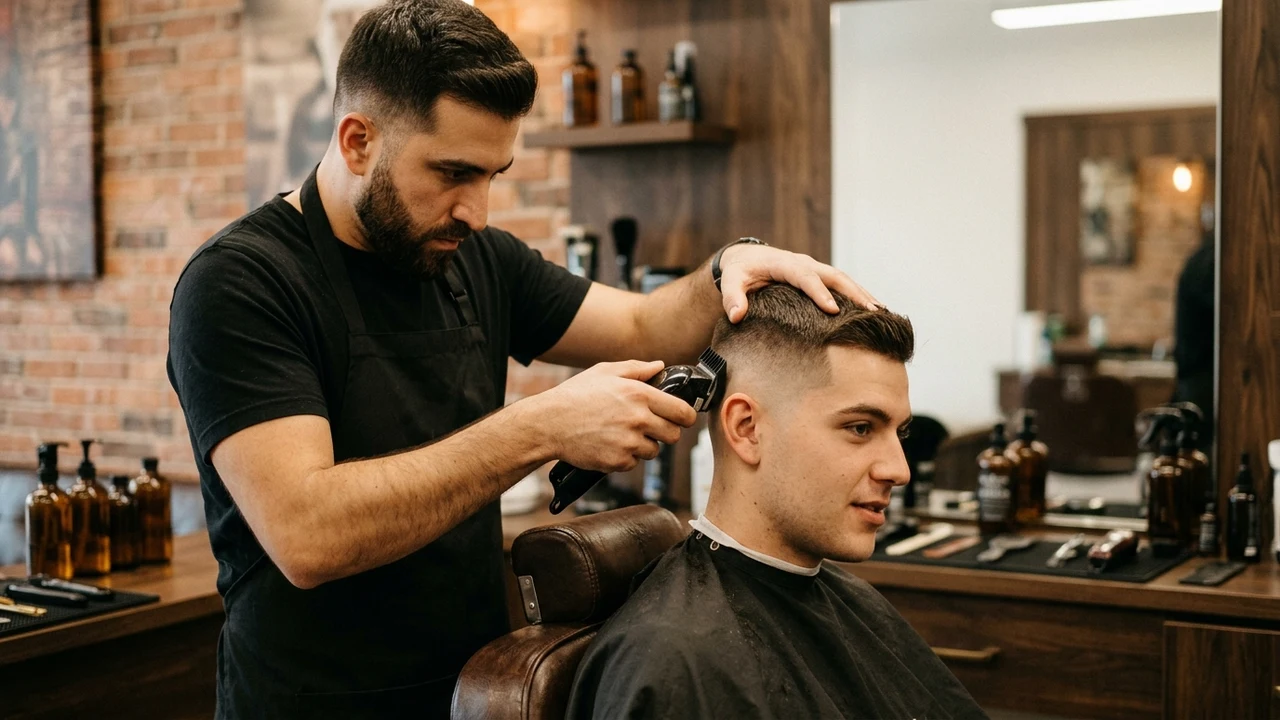
A tapered neckline gradually fades hair density down to bare skin at the natural nape contour. This represents the premier barbering standard because it grows out smoothly and naturally. Even three weeks after a cut, a tapered neckline maintains a clean, deliberate appearance without harsh, bushy growth edges.
The Blocked or Squared Neckline
A squared neckline utilizes trimmers to carve a rigid horizontal line across the base of the neck. While exceptionally crisp on day one, blocked necklines look messy and unkempt within five to seven days as stubble begins emerging beneath the artificial boundary. Unless specifically mandated by military protocol, master barbers recommend the tapered finish for superior aesthetic longevity.
The Tactical Grooming Maintenance Schedule
Because military cuts rely on dramatic contrast and skin precision, their operational lifespan is relatively short compared to longer, layered scissor cuts. Hair grows at an average rate of 0.5 inches per month, meaning a micro-short skin fade will begin losing its crispness within seven to ten days.
| Style Type | Optimal Touch-Up Window | Daily Styling Effort | Recommended Finish |
|---|---|---|---|
| High & Tight (Skin Fade) | Every 10 – 14 Days | 0 – 1 Minute | Matte texture powder or natural scalp tonic |
| Regulation Crew Cut | Every 2 – 3 Weeks | 2 – 3 Minutes | Low-shine pomade or firm matte clay |
| Ivy League Taper | Every 3 – 4 Weeks | 3 – 5 Minutes | Classic styling cream or water-based pomade |
Frequently Asked Questions
What is the difference between a high and tight and a standard skin fade?
While both styles incorporate clippers down to the skin, a standard skin fade features a gradual, feathered graduation across the entire temple and side of the head, connecting seamlessly to a longer scissor-cut top. A High and Tight features an abrupt, high boundary line where the hair drops almost immediately from top crown density directly down to skin with minimal mid-range graduation.
Will a military haircut work with receding hairlines or thinning crowns?
Yes. In fact, military styles like the High and Tight, Crew Cut, or Induction Buzz are among the most flattering haircut options for men experiencing thinning or receding temples. By cutting the sides down to bare skin, the tonal contrast between your scalp and hair density is minimized, drawing visual focus to facial features rather than receding hairline corners.
How do I describe a regulation cut to my barber?
Tell your barber you would like an Army or Navy regulation haircut: specify that you want approximately 1.5 to 2 inches of length preserved on top with sufficient length to part to the side, paired with a #1 or #2 taper on the sides that blends cleanly down to the neckline, finished with a tapered nape and clean natural razor edging.