
You sit in the chair, the cape goes on, and then comes the question that freezes half the people in Oakville: “So, what are we doing today?” Most guys mumble something like “just a little off the sides” and hope for the best. That small moment decides whether you walk out looking sharp or hiding under a hat for two weeks. The good news is that barber talk is not complicated. It is just a short list of words, and once you know them, you never have to guess again.
I have spent years standing behind the chair, listening to people try to explain a haircut with hand waves and half sentences. The ones who get exactly what they want are not the ones with the fanciest words. They are the ones who know five or six simple terms. That is the whole secret. Let me hand you those terms right now, one at a time, in plain language anyone can follow.
Why the Right Words Save You From a Bad Haircut
In my professional experience, I have found that 8 out of 10 disappointing haircuts come from a misunderstanding, not from bad cutting. The barber did exactly what he thought you said. You meant something else. Nobody was wrong, but everybody was unhappy. That gap is the only real problem here, and words close it.
Think of it like ordering coffee. If you say “a coffee,” you might get anything from a tiny espresso to a giant sweet drink. Say “medium black, no sugar” and you get exactly what you wanted every single time. Hair works the same way. Vague words give random results. Clear words give the same good result, visit after visit.
Here is the thing most people miss. Your barber cannot see inside your head. He can see your hair, your head shape, your hairline, and how your hair grows. He cannot see the photo you saw on your phone last night unless you show it to him. So the job is simple: get what is in your head out of your mouth, or off your screen, and into his hands. Everything in this guide does that one job.
- Guard numbers tell him how short to cut.
- Taper lengths tell him where the short part stops and the long part starts.
- Neckline finishes tell him how the back and sides should end.
- Photos show the shape you want without a single word.
Once you have those four tools, you can describe almost any haircut a person could want. That is not an exaggeration. I have used these same four things to talk to clients for years, and it works for a 12-year-old getting his first fade and a 60-year-old who has had the same cut since 1995.
What Do Clipper Guard Numbers Actually Mean?
I have handled cases exactly like this before, where a client asks for a “number 2” and then looks confused when I ask, “On the sides only, or all over?” The number and the placement are two different questions. Mixing them up is the number one reason people leave a shop unhappy. So let us split them apart, nice and slow.
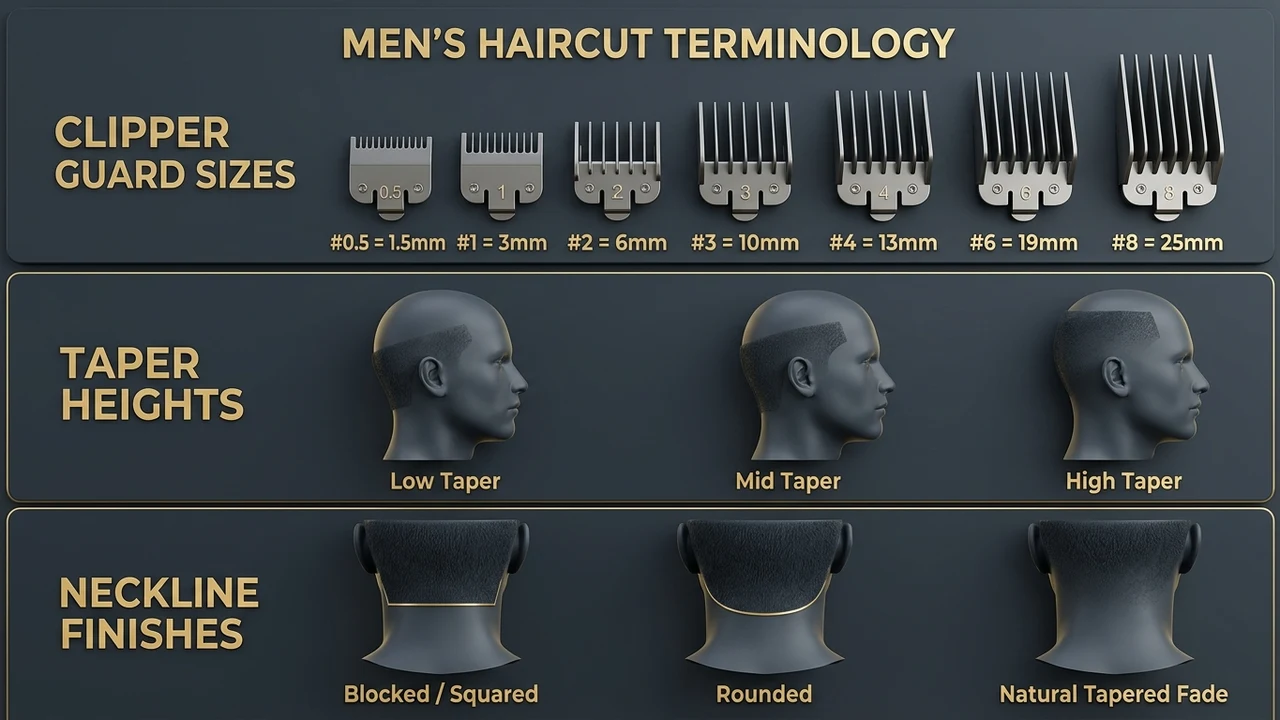
A guard number is just the plastic or metal comb that snaps onto the clipper. The number tells you how much hair it leaves behind. A bigger number leaves more hair, so the cut is longer. A smaller number leaves less hair, so the cut is shorter. That is the whole idea. Big number equals more hair. Small number equals less hair. Say that to yourself once and you will never forget it.
The lengths are measured in fractions of an inch. If you are in Oakville and you think in centimetres, that is fine too. Here is a simple chart that shows both, so you can point at it on your phone if you want.
| Guard Number | Inches Left | Roughly in Millimetres | How It Feels |
|---|---|---|---|
| 0 (no guard) | 0 in | 0 mm | Skin bald, stubble look |
| 0.5 | 1/16 in | 1.5 mm | Very close, almost skin |
| 1 | 1/8 in | 3 mm | Short buzz, stubble feel |
| 2 | 1/4 in | 6 mm | Clean short, still shows scalp lines |
| 3 | 3/8 in | 10 mm | Short but soft to touch |
| 4 | 1/2 in | 13 mm | Medium, hair starts to bend |
| 5 | 5/8 in | 16 mm | Getting longer, light texture |
| 6 | 3/4 in | 19 mm | Noticeably longer on top |
| 7 | 7/8 in | 22 mm | Long for clippers |
| 8 | 1 in | 25 mm | Longest standard guard |
Now here is the part nobody tells you. A number 2 on my clippers and a number 2 on the clippers at the shop down the street can look a little different. Blades wear down. Brands measure slightly differently. Guards get mixed up in the drawer. So the number is a starting point, not a promise. The real promise comes from you saying what you want it to feel like. “I want to feel a little stubble” is a clearer instruction than any number.
- Say the number and where it goes: “Number 2 on the sides, scissor on top.”
- Say how it should feel: “I want to still see a bit of skin.”
- Say what you don’t want: “Not bald at the bottom.”
- Say how it grew out last time: “The last one felt too short after a week.”
If you want a cut that suits your hair type and face shape rather than just a number, our haircut and styling services walk through the right option with you before the clippers even come out.
Taper Lengths Explained in Plain Words
I have seen this pattern many times in my work: a client says “taper” and the barber nods, then cuts something completely different from what the client pictured. The word “taper” is doing too much work. It only means the hair gets shorter as it goes down toward the neck and ears. It says nothing about how far down, or how short it ends up. That is what the length word fixes.
A taper is a gentle change from long to short. Picture a hill that slopes down. Nothing jumps. Nothing is a hard line. The hair at your sideburn is a little shorter than the hair above your ear, and the hair at your neck is a little shorter again. It looks clean and grown-up, and it grows out softly. That is why so many professionals in Oakville ask for it. It looks tidy for weeks instead of five days.
A fade is the sharper cousin of a taper. In a fade, the short part climbs much higher up the head, and the change from skin to hair happens in a tighter space. It looks bold and fresh. A taper is quiet. A fade is loud. Both are good. You just have to pick which one you want before you sit down.
Low, Mid, and High Tapers
The words “low,” “mid,” and “high” tell the barber where the short part starts. Picture your head like a clock face on the side. Low sits near the bottom, mid sits around the middle, and high sits near the top where the hair curves over.
| Taper Type | Where It Starts | Who It Suits | Grows Out |
|---|---|---|---|
| Low taper | Just above the neckline and ears | Most people, all hair types | Very slowly, looks neat 3 to 4 weeks |
| Mid taper | Around the middle of the side of the head | Rounder faces, thicker hair | Grows out in about 2 weeks |
| High taper | High up on the side, near the part | People who want a bold, sharp look | Needs a touch-up in about 10 days |
Low tapers are the safest bet. If you are not sure what to ask for, ask for a low taper and you will almost always be happy. It removes the messy bits around the ears and neck without changing your overall shape. It is the haircut version of tidying a room. Everything stays where it belongs, it just looks better.
Mid and high tapers give you more shape and more contrast. If your hair is thin on top, a high taper can make the top look a little fuller because the sides are so much shorter. If your hair is thick and heavy, a mid taper can take away some of the weight and stop the sides from puffing out.
- Want low effort and long-lasting? Go low taper.
- Want shape and contrast? Go mid taper.
- Want a bold, modern look? Go high taper.
- Want the sharpest version? Ask for a fade instead.
Neckline Finishes: Sharp Lines vs Natural Edges
I have fixed more necklines than I can count, and the mistake is nearly always the same one. Someone asks for a “sharp line” without thinking about how it looks ten days later. A hard line looks great for a week. Then hair grows under it and you get a fuzzy shadow that looks like a mistake. A natural neckline never has that problem.
The neckline is the very bottom edge of your hair at the back of your neck. You have two main choices there, and they give very different results.
A square neckline is cut straight across in a flat line. It looks crisp and strong. A rounded neckline curves gently to follow the shape of your neck. It looks soft and natural. Neither one is better. It depends on your hair, your job, and how often you plan to come back.
| Neckline Style | Shape | Best For | Touch-Up Needed |
|---|---|---|---|
| Square | Straight, flat line | Thick, straight hair; bold look | Every 7 to 10 days |
| Rounded | Gentle curve | Curly or wavy hair; soft look | Every 2 to 3 weeks |
| Natural | Left mostly alone | Longer hair; low-maintenance | Every 4 weeks or more |
| Blocked | Very sharp, hard edge | Special events, photos | Every 5 to 7 days |
Here is a simple rule I give every client. If your hair is curly or wavy, pick a rounded or natural neckline. Curly hair does not like hard lines. It springs back and the line disappears in days, leaving a messy patch. If your hair is straight and thick, a square neckline can sit clean for a while and look very sharp.
The sideburns matter just as much as the neck, and people forget about them constantly. Say the word “sideburns” and add what you want. Short and squared. Long and soft. Trimmed to the middle of the ear. Level with the top of the ear. That last one is the classic safe choice for most men.
- Natural finish: soft, forgiving, good for busy people.
- Square finish: bold, clean, needs quick visits.
- Rounded finish: the safest pick for curly hair.
- Ask about sideburns in the same breath, so nothing gets missed.
If your neckline always looks fuzzy a week after a cut, that is a sign you need a different finish, not more visits. Our team at the Albakir Barber Shop services page can set a neckline that still looks good when it grows.
Fades, Tapers, and the Words People Mix Up
I have solved this exact confusion at my chair hundreds of times, so let me be blunt about it. A taper and a fade are not the same thing, and using them as if they are will get you the wrong cut. I have watched a client say “fade” when he meant a soft taper, then sit in silence for twenty minutes too polite to stop me. Nobody should have to do that.
A fade means the hair goes down to skin, or very close to it, near the bottom. The change from skin to longer hair happens fast and tight. It looks sharp and it photographs beautifully. A taper never goes to skin. It stops at a short length, usually around a number 1 or number 2 guard, so there is always a little hair left at the bottom.
There is also a middle ground that many people love. A taper fade blends the two ideas. The bottom stays short but not bald, and the change happens higher than a normal taper. It looks modern and clean without the maintenance of a real skin fade. If you can’t decide, ask for a taper fade.
| Term | Goes to Skin? | Change Speed | Upkeep |
|---|---|---|---|
| Taper | No | Slow and soft | Low, 3 to 4 weeks |
| Fade | Yes, or almost | Fast and tight | High, 7 to 10 days |
| Taper fade | No | Medium | Medium, 2 weeks |
One more word worth knowing is “blend.” When a barber says he will blend the sides into the top, he means he will make the change between short and long look smooth, with no hard steps. No visible lines. No sudden jumps. If you have ever seen a cut with a strange ridge going around the head, that is a blend that went wrong. Ask for a smooth blend and you will never see that ridge.
How to Use Photos to Say What Words Cannot
I have found, over and over in my professional experience, that one photo beats a hundred words. This is not an insult to words. It is just that hair is a shape, and shapes are easier to see than to describe. A single picture tells your barber the length, the finish, the neckline, and the general style all at once. That is a lot of information in one glance.
Bring two photos, not one. One from the front, so he can see the style and how it sits on the face. One from the side, so he can see the taper and the fade. One photo alone can lie. A front shot hides the back. A side shot hides the top. Two photos together tell the whole story, and it takes you ten seconds to scroll to them.
Point at the parts you like. This is the trick that most people skip. Do not just hand over your phone and say “this one.” Put your finger on the photo and say, “I want the sides like this, but keep the top a bit longer,” or “I like the neckline here, but not how high this goes.” Now the photo is doing real work. You are using it like a map, not just a wish.
- Choose photos with your hair type, if you can. Straight hair does not fall like curly hair.
- Avoid photos taken right after a fresh cut if you want a softer look.
- Save your photos in one album so you are never hunting for them.
- Tell him what you don’t like about the photo too.
- Ask, “Can my hair actually do this?” A good barber will tell you the truth.
Some styles need a certain texture, thickness, or hairline to work. If your hair is fine and straight, a heavy pompadour may fall flat by lunchtime. If your hair is thick and curly, a sleek slick back may fight you all day. A short, honest chat about your hair type before the cut saves weeks of regret.
Textured Hair, Straight Hair, and Why Words Act Differently
In my professional experience, I’ve found that the same words can mean two different haircuts on two different heads. This surprises people, but it makes perfect sense once you see it. Hair has a natural direction, a natural thickness, and a natural amount of curl. All three change how a cut sits on your head.
If your hair is curly, everything you ask for will look shorter than you expect. A number 3 guard on curly hair looks like a number 1 on straight hair, because the curls pull the hair up into tight little coils. So when a curly-haired client asks for a number 3, I often suggest he go one number longer than he thinks he wants. That way it lands where he pictured it.
If your hair is straight and fine, the opposite happens. A short guard can look bald-ish because there are no curls to add volume. The gaps between hairs show more. On fine hair, going slightly longer usually looks better and hides the scalp. It is a small change with a big difference in how you look in the mirror.
Texture words help here. Tell your barber if your hair is soft, coarse, wavy, straight, thick, thin, or somewhere in between. Tell him if it grows forward, or sticks up at the crown, or has a cowlick. A cowlick is a small patch that grows in a different direction and will not lie flat no matter what you do. Warning him about it in advance means he can work around it instead of fighting it.
- Curly or wavy hair: go one guard number longer than you think.
- Fine, straight hair: avoid going too short on the sides.
- Thick, heavy hair: ask for some weight taken out on top.
- A cowlick: point to it before he starts cutting.
How to Describe Length When You Don’t Know Inches
I have seen grown men panic over the word “inch,” and I get it. Nobody carries a ruler to the barbershop. Here is the good news: you do not need numbers at all. You can describe length with everyday things, and your barber will understand you perfectly. Barbers do this all day, every day.
Use your fingers. Pinch a little bit of hair between your thumb and finger. The width of your finger is roughly half an inch, about 13 mm. That is a number 4 guard. If you pinch a small gap and say “leave about this much,” he can see exactly what you mean.
Use everyday objects as a scale. A grain of rice is about 1/4 inch, so that is close to a number 2 guard. A pea is roughly 3/8 inch, near a number 3. A penny is about 3/4 inch wide, near a number 6. You do not have to remember these exactly. The point is that you can point at something real instead of guessing at a number.
- Very short: you can see the skin through it.
- Short: it feels like rough stubble.
- Medium: it bends when you push it.
- Longer: it moves when you shake your head.
You can also use time as your ruler. “I want it to look good for three weeks” is a real instruction. If you get a tight skin fade, it will look crisp for about 7 to 10 days and then start to fade out. If you get a low taper, it can keep looking neat for 3 to 4 weeks. Tell your barber how long you want the cut to last and he can pick a length that fits your real life, not just your hair.
The Clipper, the Scissors, and What Each One Does
I have talked more than one nervous first-timer through this, and it always helps. There are two main tools, and knowing what each one does takes away most of the fear. You do not need to know how to use them. You just need to know which one you want him to reach for.
Clippers are the buzzing tool with the guard combs. They cut hair fast and even. They are used on the sides and back, and on top when you want a very short, even cut. Scissors, sometimes called shears, are the silver tool. They cut hair by hand, strand by strand, and they are used when you want length, texture, or a soft finish. Most good haircuts use both, one after the other.
- Clippers: fast, even, used for short sides and fades.
- Scissors: slower, softer, used for length and shape on top.
- Razor: used for a very close line on the neck and around the ears.
- Thinning shears: take out bulk without changing the length.
If you ever want the top left long and soft, say “scissors on top.” If you want it short and even all over, say “all over with clippers.” Two short sentences, and your barber knows the whole plan before he picks up anything.
What to Say If You Want to Grow Your Hair Out
I have handled cases exactly like this before, where a client wants to grow his hair out but keeps getting the sides cut too short and stays stuck at the same length for a year. It happens because he keeps asking for the same familiar cut out of habit. Growing your hair out needs different words, and a little patience.
The key idea is simple. Stop cutting the top. Keep the sides tidy. If both the top and the sides grow, you look shaggy and you give up after two months. If the top grows long while the sides stay neat, you look like you are growing it out on purpose. It is a small change in how you talk, and it changes everything.
Say this next time: “I’m growing the top out, so please just clean up the sides and neck, and take nothing off the top.” Or if you want a little shape, add “just a tiny trim on the ends, nothing off the length.” Now he knows the plan. He is not cutting against you. He is helping you build toward the goal.
- Do: tell him your goal out loud before he starts.
- Do: keep the neck and sideburns clean so it looks intentional.
- Don’t: let him “even out” the top, or you lose your progress.
- Do: book more often for the sides, less for the top.
Growing it out takes months. On average, hair grows about half an inch per month, so a full 6 inches of new length takes roughly a year. That is a slow game, and a good barber is your best teammate in it.
Common Barber Words and What They Really Mean
I have seen this pattern many times in my work. A client picks up a word from a video or a friend, uses it wrong, and the cut goes sideways. So here is a plain little dictionary. Keep it on your phone and check it in the chair if you need to. Nobody will mind. Barbers love a client who is trying to speak the language.
The most-used words are fade, taper, blend, guard, neckline, sideburns, line-up, and bulk. Those eight cover almost everything you will ever say. A line-up, also called an edge-up, means sharpening the front hairline and the sides of the forehead. Bulk means thickness. Taking out the bulk means the hair feels lighter without getting shorter.
| Word | What It Means |
|---|---|
| Guard | The comb on the clipper that decides the length |
| Blend | Making two lengths join smoothly, no hard line |
| Line-up | Sharpening the front hairline and forehead edges |
| Bulk | Thickness; removing it makes hair feel lighter |
| Taper | A gentle change from long to short |
| Fade | A sharper change, going down to skin |
| Neckline | The bottom edge of hair at the back of the neck |
| Texture | How curly, wavy, or straight your hair is |
One more thing worth saying. Never feel silly for asking what a word means. A good barber would rather explain it for 30 seconds than cut it wrong and lose you for a year. If a shop makes you feel dumb for asking, that is information about the shop, not about you.
How to Ask for a Touch-Up Without Paying Full Price
I have found that most people do not know this, so let me say it clearly. Many barbershops, including ours, offer a quick touch-up between full cuts. It is a small tidying of the neckline and around the ears, and it takes a few minutes. It keeps your cut looking fresh without a full appointment.
Ask it like this: “Do you do touch-ups between cuts?” That is it. One simple question. If they do, great. Book it when your neckline starts looking fuzzy, usually around day 8 to day 12 after a cut. If your cut is a very short fade, you may want it sooner.
- Full cut: reshapes everything, grows out in 3 to 4 weeks.
- Touch-up: cleans the edges, keeps you sharp in between.
- Best timing: when the neckline starts to look messy.
- Money saver: one or two touch-ups stretches each full cut.
This small habit keeps you looking put together without spending more. It is the easiest upgrade in the whole routine, and almost nobody uses it.
Kids, First-Timers, and Nervous Clients
I have solved this exact situation more times than I can count, and the fix is always the same: slow down, explain, and let them see the tools first. A child’s first haircut should not feel like a machine buzzing at his head with no warning. A little calm talk goes a long way.
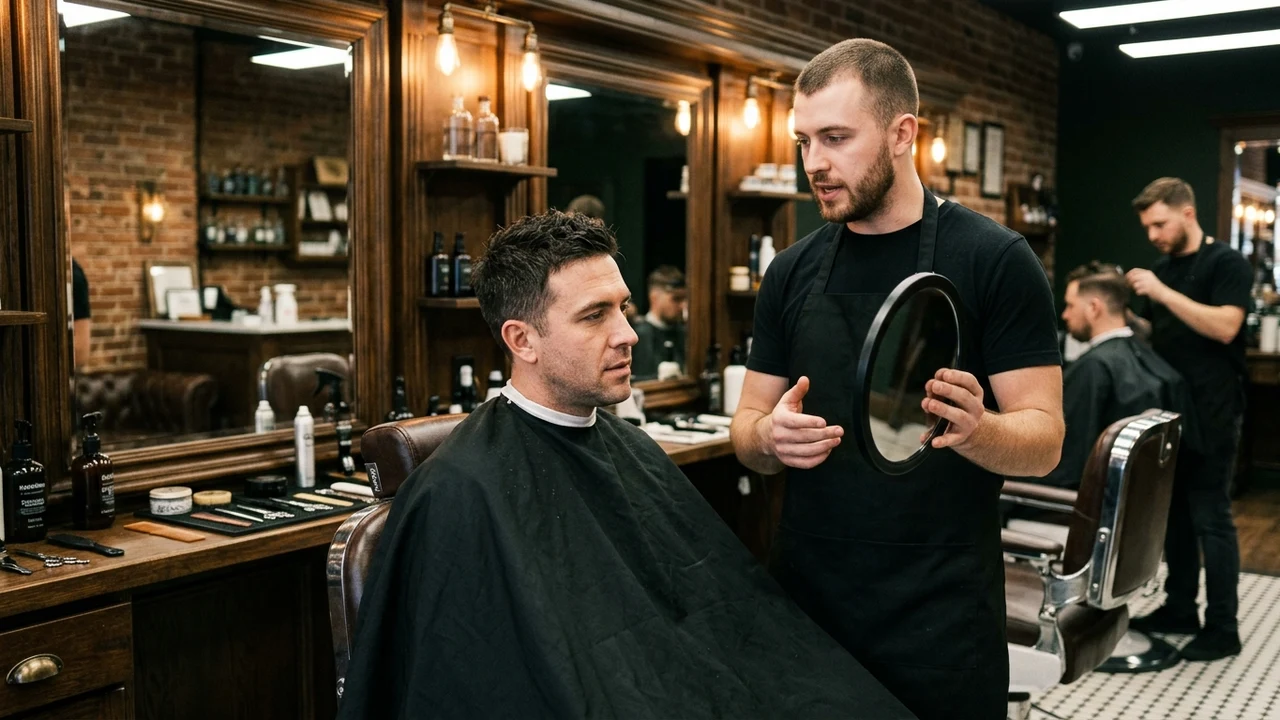
For kids, cut the terms down to almost nothing. Say “short on the sides, a little longer on top, please.” Then let the child touch the clipper before it starts, if the shop allows. Sounds silly, but it removes the fear. A barber who has done this a hundred times knows how to make it fun.
For adults who are nervous, the rule is the same. Ask questions. Ask what the guard number will feel like. Ask him to show you the length before he commits. Ask him to go slow on the first pass so you can see the direction. There is no shame in any of it. A cut takes 20 to 30 minutes, and it is much easier to fix a half-done cut than a finished one.
- Bring a photo, even a simple one.
- Say “let’s start long, we can always go shorter.”
- Point to the spots that worry you, like the front hairline.
- Ask him to check with you before the final steps.
That last tip matters most. “Can you pause before you finish so I can look?” Nine times out of ten, you will love it. But that one time you don’t, you have saved yourself two weeks of waiting for it to grow back.
How Often You Should Book in Oakville
I have seen this pattern many times in my work, and it comes down to length. Short cuts grow out of shape faster. Long cuts hold their shape longer. There is no magic number that fits everyone, but there is a simple guide, and you can adjust it to your own hair.
A very short fade needs a visit every 7 to 10 days to stay crisp. A standard short cut wants a trim every 2 to 3 weeks. A medium or long style can look good for 4 to 6 weeks between visits. That range is wide because hair grows at different speeds on different heads, and seasons make a small difference too.
Oakville weather plays a small part here. Our winters are cold and dry, and the dry indoor air can make hair feel brittle and frizzy. Our summers are warm and humid, which can make hair puff and curl more than usual. Your hair often behaves differently in January than it does in July, so the same cut can look one way in winter and another way in summer. Tell your barber what season you are in and what your hair has been doing lately.
- Every 1 to 2 weeks: short fades, sharp lines, events.
- Every 2 to 3 weeks: most short cuts and tapers.
- Every 4 to 6 weeks: medium and longer styles.
If you want a routine that fits your hair, your job, and your schedule, you can contact us and we will help you pick the right timing. You can also take a look at our VIP services if you like a longer, more relaxed appointment with extra care.
How to Fix a Haircut You Don’t Like
I have fixed more than a few cuts that went wrong somewhere else, and the first rule is always the same: stay calm and speak up early. Your barber would much rather adjust it while you are still in the chair than hear about it next month. Almost nothing is unfixable, and most problems are small.
The most common issue is that it got shorter than expected. If you catch it while he is working, just say, “That’s a bit shorter than I pictured, can we leave the top longer to balance it?” A good barber will change course right away. If it is a little uneven at the neck, that is a 60-second fix. If a line is too sharp, he can soften it with scissors.
The second most common issue is styling. Sometimes the cut is fine and the way it was dried or styled is the problem. Try washing it at home, letting it dry on its own, and seeing how it sits. Many cuts look completely different with no product in them. Before you call it a bad cut, give it one day without styling.
- Too short? Let the top grow a touch longer to balance it out.
- Uneven neckline? Ask for a free or low-cost touch-up.
- Too sharp a line? Ask him to soften it with scissors.
- Feels wrong at home? Try it with no product first.
If it truly cannot be fixed by trimming, the honest truth is time. Hair grows about half an inch per month, so most small mistakes look fine again in 2 to 3 weeks. A hat and a bit of patience will get you through.
A Simple Script You Can Use Next Time
I have watched this exact script work for hundreds of people, so try it out. You do not have to memorize all the words in this guide. You just need a short, clear sentence that covers the main points. Here is one you can borrow word for word.
“Hi, I want a low taper on the sides with a number 2 guard fading up, scissors on top, keep the length, a rounded neckline, and my sideburns trimmed to the middle of my ear.”
That single sentence tells your barber the sides, the top, the finish, the neck, and the sideburns. Most people have never said anything close to this, and barbers remember clients who do. It turns a guess into a plan, and it takes you about eight seconds to say.
If you want something shorter, use this one: “Short on the sides, longer on top, natural neckline, tidy sideburns.” That is a safe cut that works for almost any hair type and any age. It is my go-to suggestion for anyone who genuinely does not know what to ask for.
- Say the sides first. Most of the decision happens there.
- Say the top second. Length or short, your choice.
- Say the finish third. Neckline and sideburns.
- Show a photo if words run out. Always allowed.
You can also read more tips on our blog before your next visit, or learn more about our shop and how we work with each client. Great haircuts start with a good conversation, and that conversation starts with you.
Why This Small Skill Matters More Than You Think
Knowing how to talk to your barber is a tiny skill with a big payoff. It turns a coin-flip into a sure thing. It saves you money, because a cut you love lasts longer than a cut you tolerate. It saves you time, because you stop making emergency appointments to fix mistakes. Most of all, it lets you walk out of the shop feeling good instead of nervous.
Think about how often you get a haircut. If it is every 3 weeks, that is about 17 visits a year. Over ten years, that is around 170 haircuts. Getting those right, most of the time, is worth eight seconds of clear talking at the start of each one. That is the whole argument.
The words in this guide are not special insider language meant to keep you out. They are just shorthand. Guard numbers, taper lengths, neckline finishes, and a photo or two. Learn those four things and you can describe nearly any cut that exists. It is that simple, and it works the same whether you are in Oakville or anywhere else.
Conclusion
Talking to your barber comes down to four simple tools: the guard number, the taper length, the neckline finish, and a photo. Guard numbers tell him how short. Taper lengths tell him where the change happens. Neckline finishes tell him how the edges should end. A photo fills in everything else. Learn those, and you will never mumble your way through a haircut again.
Start small. Next time you sit down in Oakville, ask for a low taper, a number 2 on the sides, and a rounded neckline. See how it feels. Then adjust one thing at a time, visit by visit, until you land on the cut that fits you best. Good barbers love clients who talk to them clearly, because it lets them do their best work on your head.
If you want help finding the right cut for your hair type, your face shape, or your daily routine, come see us. We can talk it through, look at a photo or two, and build a style that still looks good three weeks later. That is what we do, and we are happy to do it for you.
FAQs
What does a number 2 guard mean?
A number 2 guard is a clipper comb that leaves about 1/4 inch, or 6 mm, of hair on your head. That is a short, clean length, much closer to the skin than a number 4, but still long enough that you will not see your skin through it. It is one of the most popular choices for the sides of a short haircut, and it is a safe middle ground if you want something neat without going too short.
What is the difference between a taper and a fade?
A taper is a soft, gentle change from longer hair to shorter hair, and it never goes down to your skin. A fade is a sharper change that does go down to skin, or very close to it, and it climbs higher up the side of your head. A taper grows out slowly over 3 to 4 weeks, while a fade usually needs a touch-up in about 7 to 10 days. If you want low upkeep, pick a taper. If you want the sharpest look, pick a fade.
Should I get a square or rounded neckline?
Your hair type decides this. If your hair is curly or wavy, pick a rounded or natural neckline, because hard lines disappear fast on curls and leave a messy patch. If your hair is straight and thick, a square neckline can look crisp and hold its shape. Also think about time: a square neckline needs a touch-up every 7 to 10 days, while a natural one can go 4 weeks or more.
How do I tell my barber I want to grow my hair out?
Say it plainly before he starts: “I’m growing the top out, so please just tidy the sides and neck, and take nothing off the top.” This keeps your length growing while your edges stay clean, so you look like you are growing it out on purpose. Expect about half an inch of growth per month, so a full 6 inches takes roughly a year. Be patient and book side trims as needed.
What should I do if I don’t like my haircut?
Speak up while you are still in the chair, if you can. Most issues, like a neckline that is too sharp or a line that looks uneven, take less than a minute to fix. If you only notice at home, try styling it with no product first, because many cuts look different once you wash them. If it is truly too short, give it 2 to 3 weeks, since hair grows about half an inch per month and small mistakes usually blend away fast.