
In contemporary men’s grooming, few technical haircuts command as much precision, artistry, and aesthetic impact as the fade. A masterfully executed fade is not merely a short haircut – it is a customized optical gradient that sculpts the head, accentuates strong facial features, and balances natural cranial symmetry. However, walking into an upscale barbershop and simply asking for “a fade” often leads to misunderstandings, because blend height and taper placement completely alter the visual silhouette of your haircut.
The three most requested modern fade styles – the Skin Fade, the Drop Fade, and the Low Fade – each deliver a distinct aesthetic profile tailored to specific head shapes, hair textures, and maintenance preferences. Understanding the anatomical geometry and blending mechanics behind each variation ensures you select the optimal blend height to elevate your everyday appearance.
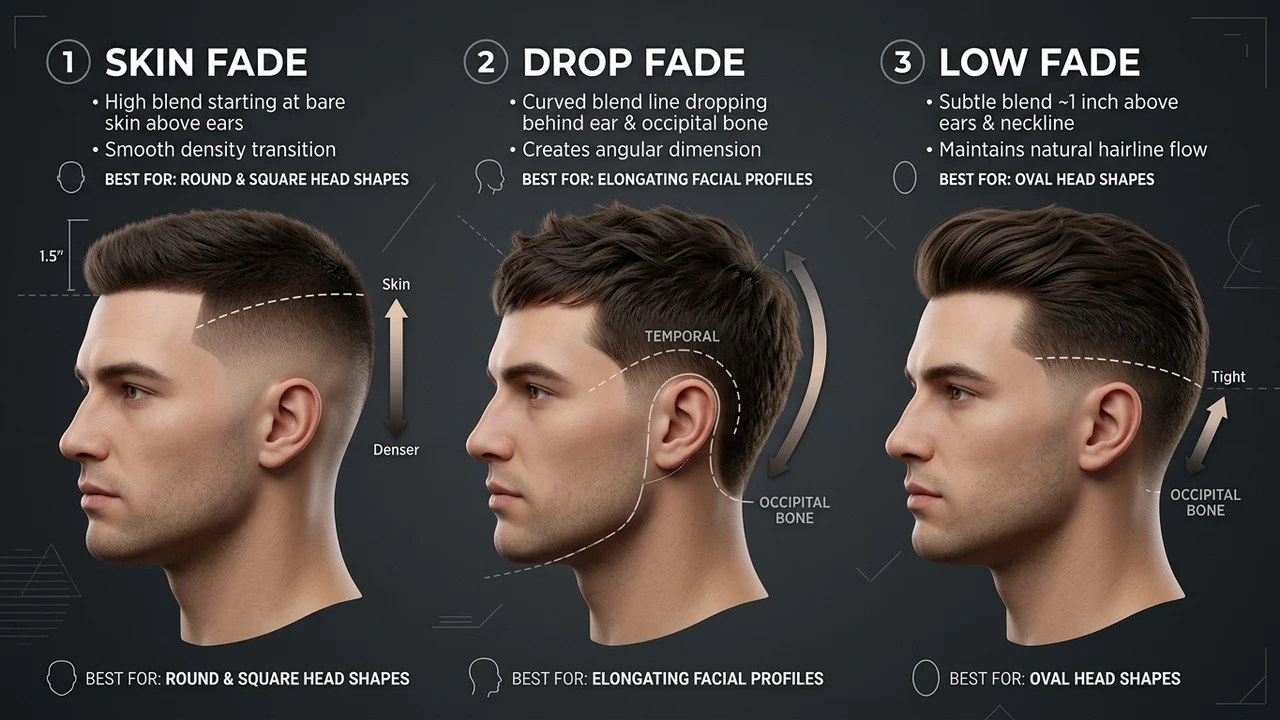
1. The Skin Fade: Maximum Contrast and Razor-Sharp Precision
Also recognized throughout the industry as a bald fade or high-contrast fade, the Skin Fade takes the hair completely down to bare skin at the lowest perimeter before systematically blending upward into the desired length on top. Master barbers utilize foil shavers or straight razors at the base of the hairline to achieve zero-stubble glass smoothness, creating an aggressive, ultra-clean contrast that instantly sharpens facial lines.
Depending on preference, skin fades can be placed at high, medium, or low transition thresholds. In a High Skin Fade, the blend starts tapering near the temple peak and parietal ridge, leaving the sides almost entirely clean. This style creates a tall, vertical illusion that is particularly flattering for gentlemen with round, square, or wider jawline structures, as it removes bulk from the temporal zones and visibly elongates facial proportions.
2. The Drop Fade: Dynamic Contouring Around the Occipital Bone
While standard fades follow a relatively horizontal blend line encircling the skull, the Drop Fade introduces an intentional curved arc that dips downward as it travels toward the back of the head. Following the natural curvature of the cranial skeleton, the blend line drops below the occipital bone at the nape of the neck rather than maintaining a level horizontal trajectory.
This subtle downward dip serves two vital aesthetic functions. First, it preserves natural hair density over the crown and upper neck, preventing the flat or boxy silhouette that can occur when high fades cut straight across an uneven occipital ridge. Second, the sloping angle creates dramatic profile dimension, making the Drop Fade the premier choice for individuals with flatter head profiles, prominent crown whorls, or oblong facial features who need balanced visual weight between the temple and neck.
3. The Low Fade: Subtle Elegance and Professional Versatility
For men who prefer an understated, classic aesthetic or work in corporate environments requiring traditional grooming, the Low Fade offers the perfect balance between clean refinement and conservative proportion. A low fade begins its blend just a half-inch to one inch above the natural neckline and ears, leaving substantial hair density throughout the sides and temporal bones.
Because the blend occurs low on the skull, the low fade maintains natural hair flow, allowing for classic side parts, slickbacks, textured crops, or natural curls without exposing the scalp along the temples. It is exceptionally well-suited for gentlemen with oval head shapes or those possessing natural surface irregularities, scars, or prominent parietal ridges that benefit from full hair coverage.
Matching Fade Height to Your Cranial and Facial Architecture
A master barber does not cut hair in a vacuum – they evaluate bone structure, ear placement, hair density, and hairline geometry before clipping a single strand. Consider the following architectural rules when choosing your fade style:
- Round Face Shape: Opt for a Mid-to-High Skin Fade. Removing maximum bulk from the sides visually narrows the face and adds vertical height to your profile.
- Square Face Shape: High Fades and Clean Skin Tapers accentuate strong jawlines and cheekbones, enhancing masculine angularity.
- Oblong or Elongated Face: Choose a Low Fade or subtle Drop Fade. Keeping density along the sides prevents the head from appearing excessively tall or narrow.
- Prominent Occipital Ridge or Flat Crown: Choose a Drop Fade. The downward curved blend masks cranial unevenness while enhancing the natural curvature of the skull.
Clipper Gradations and the Art of the Taper Transition
Achieving an airbrushed, seamless fade requires intricate clipper mechanics. Professional barbers utilize adjustable clipper levers and specialized magnetic guards, stepping incrementally from #00000 (bare skin) through #0.5, #1, #1.5, and #2 guards, employing a rhythmic “C-scoop” wrist motion to flick outward at each guideline.
To blend the transition between clipper guard length and the scissors-cut top, a skilled barber employs scissor-over-comb or clipper-over-comb techniques. This meticulous graduation prevents heavy horizontal weight lines, allowing the hair to lay naturally without mushrooming or separating during daily styling.
Maintenance Cycles and Daily Styling Essentials
Because fades rely on micro-millimeter length differentials, maintaining razor-sharp cleanliness requires routine upkeep. Skin fades and high fades generally require touch-ups every one to two weeks to keep the skin area smooth and the transition crisp. Low fades and softer drop tapers can comfortably extend to three to four weeks between appointments as the gradient grows out more gradually.
To style your fade at home, invest in premium water-based pomades for sleek, structured finishes, or lightweight matte styling clays and texturizing powders for modern, effortless volume. Applying a nourishing beard or hair tonic keeps the skin along the fade moisturized, preventing dry scalp flaking and ensuring your haircut looks freshly tailored every single day.